


How Can QA Testing Keep Pace with AI-Powered Software Development?

QA testing can keep pace with AI-powered software development by combining AI-assisted automation with human expertise and oversight. Organizations that strengthen testing foundations, expand coverage and use AI strategically can close the confidence gap and release software with greater confidence.
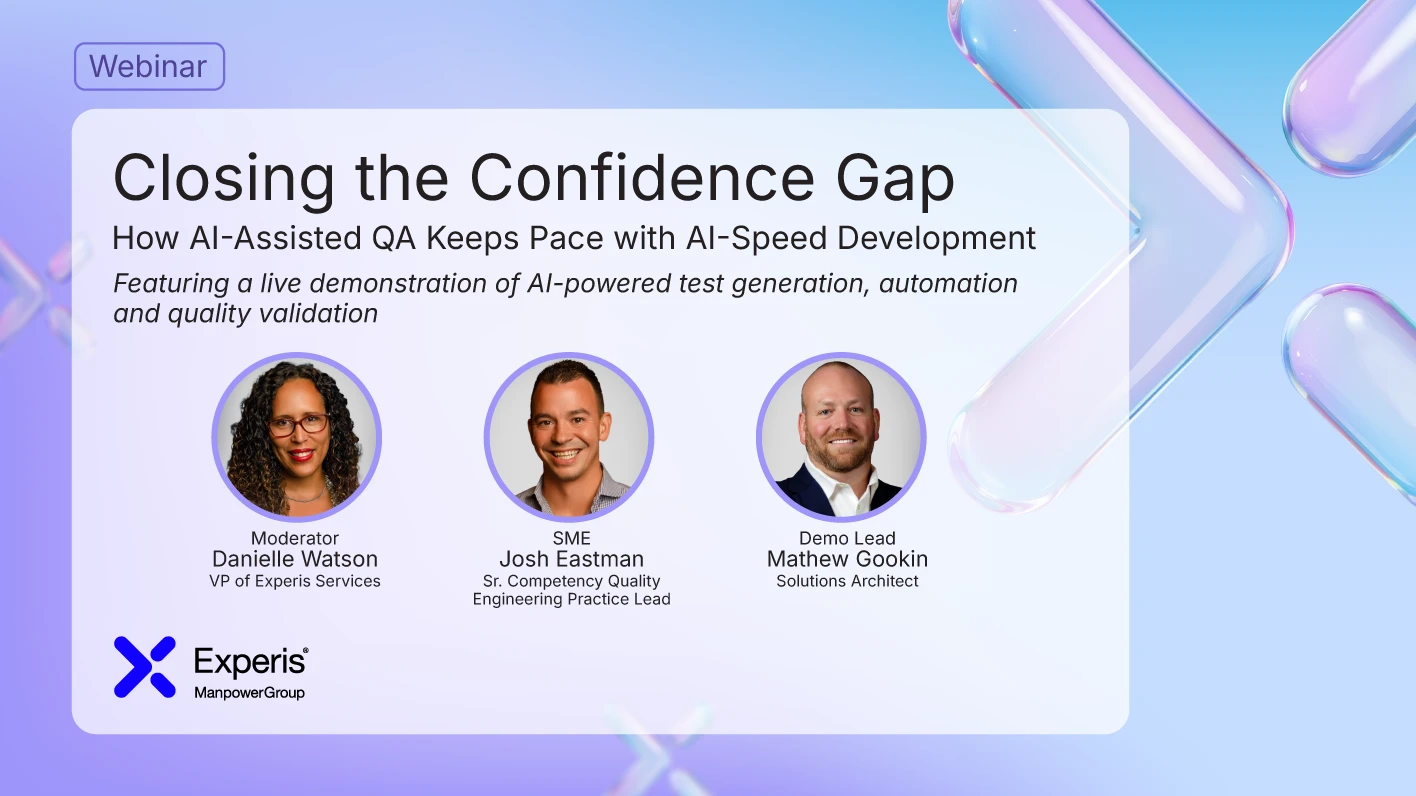
AI is transforming software development. Teams can generate more code, deliver more features and move from idea to deployment faster than ever before. But as development accelerates, many organizations face a new challenge: How do you maintain confidence in quality when testing can't keep pace with production?
That question was at the heart of Experis' recent webinar, Closing the Confidence Gap: How AI-Assisted QA Keeps Pace with AI-Speed Development. Featuring Experis experts Josh Eastman, Danielle Watson and Matt Gookin, the discussion explored how organizations can use AI-assisted QA testing to close the growing gap between development speed and release confidence.
How AI-Powered Software Development Is Creating a QA Confidence Gap
AI-assisted development is helping organizations produce software at unprecedented speed. Yet many testing organizations are still operating with limited automation, incomplete documentation and resource constraints that make it difficult to validate software at the same pace.
As Josh Eastman explained:
The confidence gap is the growing distance between how fast we can build and how confidently we can validate and release.
The impact is already being felt across the industry. Research from SmartBear highlighted during the webinar found that 70% of software leaders report declining application quality as AI-generated development accelerates, while 68% worry testing cannot keep pace.
The consequences extend well beyond IT departments. A quality failure can affect customer experience, operations, revenue and brand trust.
As Danielle Watson noted, development teams can deliver new features and functionality faster than ever before, but the responsibility for validating those solutions still falls on QA. When quality breaks down, organizations can face financial, operational and reputational consequences. As Danielle explained:
AI has rapidly accelerated the process for delivering new features and functionality, but the finger is ultimately pointed at QA teams to make sure that these solutions work as intended.
The webinar pointed to the 2024 CrowdStrike outage as a reminder of what is at stake. A faulty update disrupted airlines, hospitals and businesses around the world, resulting in an estimated $5.4 billion in losses among Fortune 500 companies alone.
How AI-Assisted Software Testing Improves Release Confidence
One of the webinar's central themes was Experis' human first, digital always philosophy.
While AI is creating new opportunities to improve software testing, the panelists consistently emphasized that technology works best when paired with human expertise and oversight.
Organizations often rush to implement AI tools before establishing the foundations needed for success. During the discussion, speakers compared the situation to building a faster train without first putting down better tracks. Documentation, requirements, governance and testing processes remain essential.
Many organizations want to adopt AI immediately, but the reality is that understaffed QA teams, incomplete documentation and knowledge trapped in employees' heads can limit the value AI delivers. Successful AI-assisted QA testing, enabled by human expertise, begins with building those foundations first.
Josh Eastman makes the argument for QA teams assisted by AI:
The future of testing is testers partnering with agents.
Rather than replacing QA professionals, AI helps eliminate repetitive work so teams can spend more time evaluating risk, validating business outcomes and making decisions that require human judgment.
Human expertise remains the differentiator. AI can surface insights, identify gaps and accelerate execution, but it is people who provide context, oversight and decision-making. That's the essence of human first, digital always and a recurring theme throughout the webinar.
What AI-Assisted Software Testing and QA Looks Like in Practice
The webinar moved beyond theory and into practical application with a live demonstration from Matt Gookin.
The demonstration showed how AI agents can help teams review requirements, identify gaps, generate test cases, develop automation and analyze results while keeping humans involved at critical decision points.
Instead of starting with perfect documentation, AI can help teams:
- Analyze existing applications and requirements
- Identify ambiguities and missing acceptance criteria
- Generate test scenarios
- Recommend automation opportunities
- Highlight areas of elevated risk
- Surface defect trends and coverage gaps
A particularly valuable use case discussed during the session involved using AI to analyze historical defect patterns and identify application hot spots where failures occur most frequently. This helps teams focus testing efforts where quality risks are highest and improve risk-based test prioritization.
The live demonstration walked through a complete workflow. AI agents reviewed a user story, flagged missing acceptance criteria, identified ambiguities, generated test cases, created automation scripts, executed those tests and returned results to Jira. At each stage, human reviewers validated outputs and approved the next step before the process moved forward.
As Matt Gookin explained:
While AI is assisting in our process, we're the ones that are reviewing and approving it.
The demonstration reinforced a key message repeated throughout the webinar: AI-assisted software and QA testing is not about removing people from the process. It's about helping experienced teams improve coverage, identify risks sooner and move more confidently from development to release.
Quality Remains a Business Issue, Not Just a Testing Issue
The speakers stressed that software quality should not be viewed as a standalone QA concern.
Throughout the discussion, the panel connected quality directly to customer experience, business performance and organizational trust. The webinar contrasted the reactive consequences of quality failures with the proactive approach taken by organizations such as Netflix, which uses chaos engineering practices to intentionally stress-test systems and build resilience before problems occur.
The lesson for leaders was clear: speed alone is not a competitive advantage. Sustainable innovation requires quality practices that scale alongside software development.
From Automation to Confidence
One of the most compelling real-world examples shared during the webinar involved helping an Experis client move from virtually no automation testing to approximately 80% automated test coverage in just 12 weeks.
Yet the panel argued that the biggest return on investment often isn't labor savings.
The greater value comes from expanding test coverage, identifying risks earlier, reducing ambiguity and increasing confidence in software releases. More coverage means fewer surprises in production, fewer escaped defects and better outcomes for customers.
For many organizations, confidence is the missing metric. When teams understand what has been tested, where risks exist and how changes affect the application, they can innovate more aggressively without sacrificing quality.
A Five-Step Roadmap for AI-Assisted QA
For organizations looking to begin their AI-assisted QA journey, the panel recommended a practical framework:
- Assess current QA capabilities and processes.
- Prioritize the areas where AI can create the greatest impact.
- Pilot focused use cases.
- Measure outcomes and business value.
- Scale successful practices across the organization.
This phased approach helps organizations demonstrate value quickly while establishing the governance, standards and operational foundations needed for long-term success.
Key Takeaways for Technology and QA Leaders
- AI is accelerating software development faster than many QA organizations can validate software.
- The growing confidence gap creates risks for application quality, customer experience and business performance.
- Experis' human first, digital always approach combines AI with human expertise rather than replacing it.
- Strong foundations, including documentation, governance and testing standards, increase the value of AI initiatives.
- AI-powered QA, enabled by human expertise, can help organizations generate tests, improve documentation, identify risk and expand automation coverage.
- Human oversight remains critical throughout the testing lifecycle.
- Successful AI adoption starts with measurable pilots and a plan for scaling proven results.
Closing the Confidence Gap
So, how can QA testing keep pace with AI-powered software development?
It’s not by choosing between people and technology. The organizations making the most progress are using both.
AI can help testing teams increase speed, scale and coverage. Human expertise provides the judgment, context and decision-making required to ensure quality outcomes. Together, they help organizations close the confidence gap, reduce risk and innovate with greater confidence.
Watch the Webinar On Demand
Want to see QA in action?
Watch our on-demand webinar to see the live demonstration from Matt Gookin, hear practical guidance and explore the strategic perspective shared by our experts.
If you're evaluating how AI can improve software quality, increase testing coverage or strengthen release confidence, contact Experis to discuss your goals. Our team can help assess your current environment, identify high-value opportunities and build a roadmap for AI-assisted QA testing.